

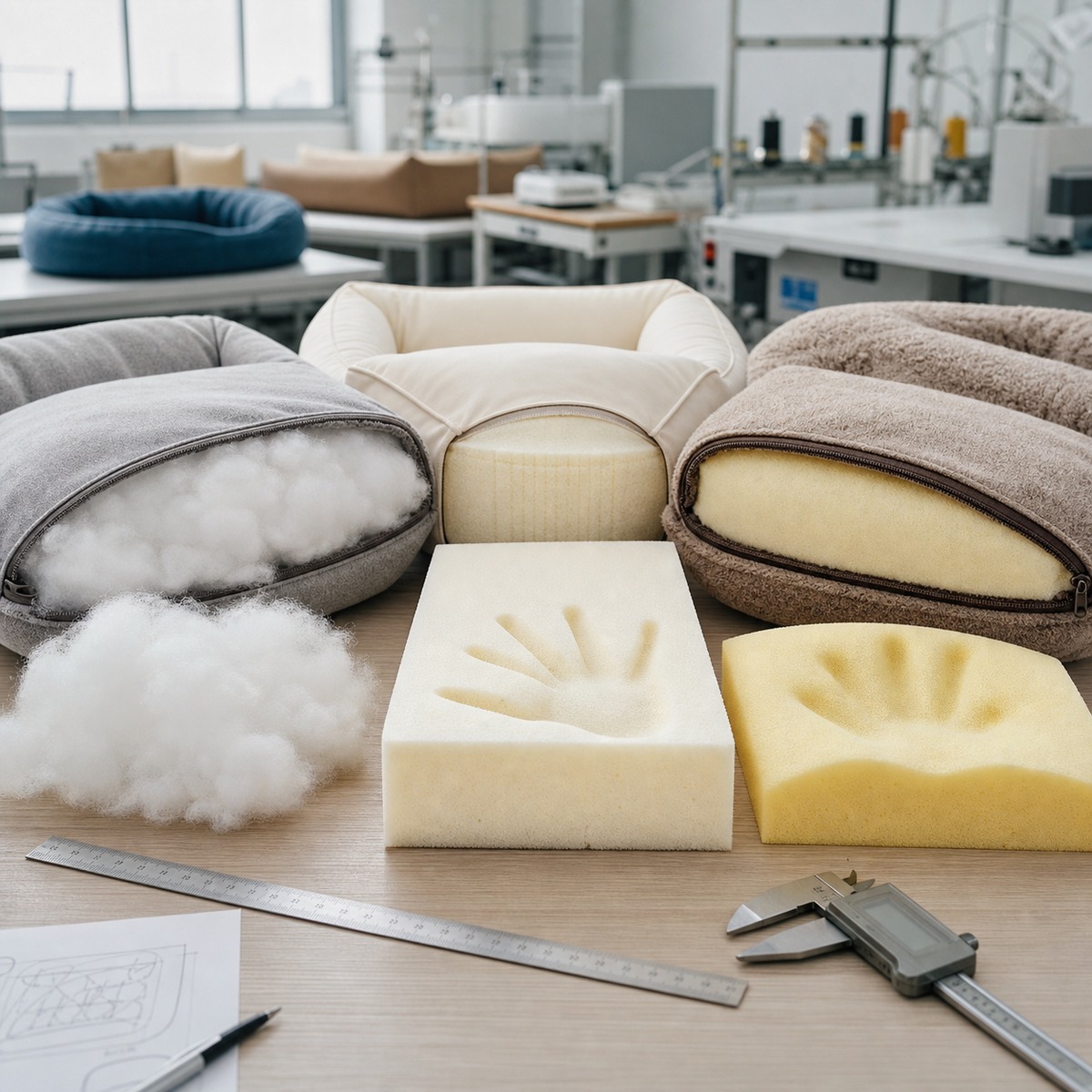
Same outer shell, completely different buying experience. Here is how the three most common pet bed fillings compare — and which one fits your channel, customer, and price point.
Most wholesale buyers spend a lot of time picking the right fabric. Far fewer spend enough time on the filling — which is a mistake, because the filling determines how the bed feels, how long it lasts, and whether the end consumer needs to hand-wash or can throw it in the machine. These three factors directly affect your returns rate, your repeat order potential, and your positioning on the shelf or the listing page.
This guide breaks down exactly what each filling is, what it costs, and who it is for.
PP Cotton
Soft, bouncy, and price-efficient. The default choice for high-volume wholesale buyers and Amazon private-label sellers.
Memory Foam
High resilience and genuine structural support. The go-to filling for large-breed buyers and design-forward retail channels.
Slow-Rebound Sponge
Slower, softer response that molds to the pet's body. Appeals to buyers positioning their products as comfort or wellness-focused.
PP Cotton — The Volume Workhorse
PP Cotton (Polypropylene Fiber Fill)
PP Cotton is exactly what it sounds like — loose fiber fill that creates a plush, huggable sleeping surface. It is light to the touch, easy to compress for shipping, and comes back with satisfying loft when you fluff it. For small and medium-sized dogs and cats, it provides adequate comfort without any issues. It is also the most forgiving fill when it comes to washing — PP Cotton can go into the machine together with the removable cover, which is a significant advantage for end-consumers who want easy maintenance.
The trade-off is longevity. Based on factory data and order feedback, PP Cotton filling starts to lose resilience measurably after about six months of regular use — by that point, the fill has compressed and the bounce-back rate has dropped by roughly 20%. For pets that use their bed daily, the visible flattening happens faster than buyers typically expect.
Who Buys PP Cotton Beds
- Amazon private-label sellers — Volume-driven buyers who need competitive FOB pricing and clean listing metrics. PP Cotton's lower cost (roughly 10% below foam options) lets them hit the price points that move units.
- Mass-market retailers — Buyers whose consumers are price-sensitive and replacing beds seasonally rather than expecting them to last years.
- Small breed and cat specialists — Lighter animals do not compress PP Cotton as quickly as larger breeds, so the durability shortfall matters less in practice.
Key claim to avoid: Do not describe PP Cotton beds as "orthopedic" or position them with senior or large-breed messaging. The fill cannot support heavier animals the way foam can, and buyers who select it for those use cases will see returns. Keep the messaging honest — comfort, softness, value.
Memory Foam — The Large-Dog Standard
Memory Foam (Viscoelastic Foam)
Memory foam was originally developed for pressure relief and joint support — properties that translate directly into pet bedding for large or aging dogs. When a 30kg Labrador lies down on a memory foam bed, the foam distributes weight evenly across the surface rather than letting pressure concentrate at the hips and elbows. That is why veterinary-adjacent brands and specialty pet retailers default to memory foam for their large-breed lines. The fill holds its shape and support level for significantly longer than fiber fill — a well-made memory foam bed used by a large dog will typically remain functional for two or more years before needing replacement.
Memory foam also photographs exceptionally well and pairs naturally with premium aesthetics. Buyers in Europe and North America who are positioning their products alongside furniture — structured silhouette, neutral palette, interior-design appeal — gravitate toward memory foam because the product visually signals quality in a way that fluffy fiber fill does not.
Who Buys Memory Foam Beds
- Large-breed specialists — German Shepherd, Golden Retriever, and similar breed communities are very active online and specifically search for orthopedic or supportive filling.
- Senior pet segment — Aging dogs with joint issues are a growing and high-value segment. Buyers targeting this market almost always require foam fill.
- Premium retail and specialty stores — Buyers whose channel carries $80–$150+ retail price points. Memory foam justifies the price premium and holds up to customer scrutiny.
Washability note: Memory foam cannot go in the washing machine — water and agitation will break down the foam structure. The removable cover should be machine-washable, but the foam insert needs to be spot-cleaned or air-dried only. This is not a flaw to hide; it is a care instruction that needs to be clearly stated in your listing. Buyers who do not know this and machine-wash the entire bed will create returns and negative reviews.
Slow-Rebound Sponge — The Comfort Middle Ground
Slow-Rebound Sponge (Low-Resilience Foam)
Slow-rebound sponge occupies the space between PP Cotton's softness and memory foam's firmness. Press your hand into it and it sinks gently, conforms around your hand, and then slowly returns to shape when you lift away — that characteristic slow recovery is both the product's defining feature and its main selling point. For pets that curl, burrow, or sleep in unusual positions, the conforming quality is genuinely comfortable in a way that a flat, resilient surface is not.
Unlike memory foam, slow-rebound sponge has a softer, more yielding texture that feels less clinical and more luxurious. This makes it a strong fit for lifestyle-oriented brands that want the comfort story without the medical positioning. Think premium cat beds, small-breed specialty products, or any line marketed around the idea that your pet deserves the same quality of sleep experience that you do.
Who Buys Slow-Rebound Sponge Beds
- Mid-premium lifestyle brands — Buyers who want a step up from PP Cotton comfort but prefer a softer, warmer aesthetic than memory foam delivers.
- Cat-focused buyers — Cats tend to prefer surfaces that conform to their body shape. Slow-rebound sponge suits the curled sleeping positions that cats prefer.
- Small and medium breed specialists — The conforming softness is most effective for lighter animals. For large breeds, memory foam's firmer support is generally the better recommendation.
Same washability rule as memory foam: The sponge insert cannot be machine-washed. The removable cover can and should be machine-washable, but the foam must be kept dry and spot-cleaned only. Make sure this is communicated clearly in your product listing.
How Long Does Each Filling Actually Last?
Filling lifespan affects your customers' repurchase cycle — and your product's reviews. Here is a realistic breakdown based on factory data and buyer feedback.
Note: Lifespan varies by foam density, pet weight, and usage patterns. Heavier animals compress filling faster. Always specify foam density (kg/m³) when placing production orders.
Which Filling Should You Order?
The right answer depends on your price point, your channel, and your target pet size. Use this table to narrow it down before requesting samples.
| Filling | Best Pet Size | Washability | Durability | Channel Fit |
|---|---|---|---|---|
| PP Cotton | Small & medium / cats | Machine wash with cover ✓ | 6–12 months | Amazon, mass retail, budget positioning |
| Slow-Rebound Sponge | Small, medium / cats | Cover only — spot clean insert | 12–24 months | Mid-premium, lifestyle brands, cat specialists |
| Memory Foam | Large breeds / seniors | Cover only — spot clean insert | 2+ years | Specialty pet stores, orthopedic positioning, premium retail |
The Washability Rule — Easy to Get Wrong
- PP Cotton is the only filling that can go in the washing machine together with the removable cover — a real convenience advantage worth highlighting in listings
- Both memory foam and slow-rebound sponge require the insert to be kept separate from the wash — this must be stated clearly in your product descriptions and care instructions
- Removable, washable covers are expected by buyers in all markets regardless of filling choice — do not source beds without them
Ready to Sample All Three Fillings Side by Side?
Browse our pet bed collection and contact us to request fill comparison samples — we can prepare the same style in PP Cotton, slow-rebound sponge, and memory foam for direct comparison.
Browse the Collection