

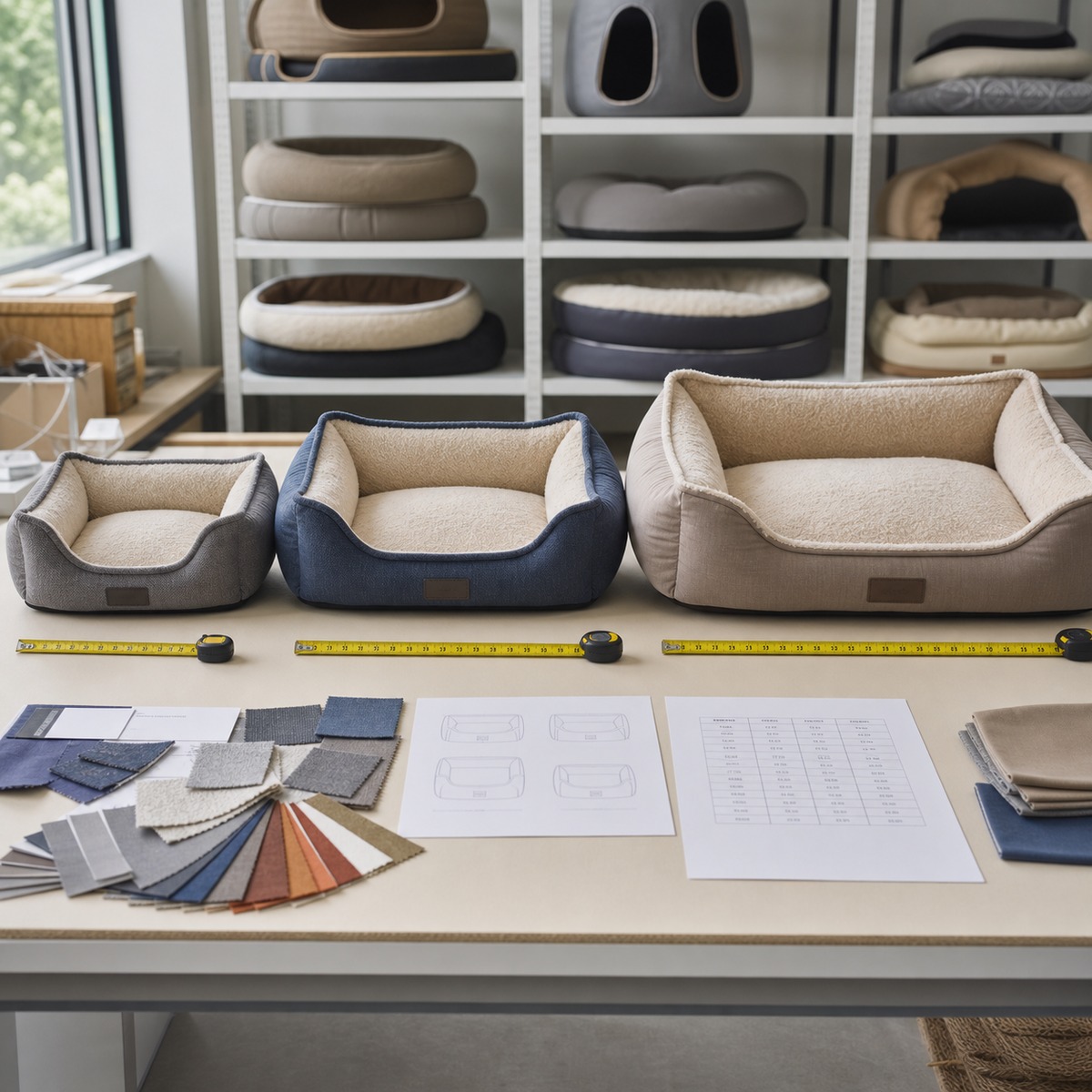
The right size is the single most important spec decision you will make when sourcing pet beds. This guide gives you the exact dimensions, the formula, and the market context to get it right the first time.
Sizing errors are the most common — and most avoidable — mistake wholesale buyers make. A bed that is too small generates returns and negative reviews. A bed that is too large increases shipping costs and takes up shelf space. This guide covers PetFangFang's standard size specifications, the selection formula that works across all markets, and the key differences buyers in the US, Europe, South America, the Middle East, and Central Asia should know.
PetFangFang Standard Dog Bed Dimensions
Our standard dog bed sizes are consistent across the product range. These dimensions represent the finished outer measurements of the bed — the interior usable space is slightly smaller depending on bolster construction.
Height dimension explained
The height measurement (13–17 cm) refers to the total bed height including the bolster rim and base cushion. This is not the interior depth — a dog lying in the bed will rest on the base cushion, with the bolster rising around them. For bolster-specific height requirements by breed size, see the bolster guide section below.
The Size Selection Formula
Rather than guessing by breed name, use these three measurements to select the correct size. Breed names are inconsistent across regions — the same "medium dog" in North America may be classified differently in Germany or Saudi Arabia. Actual body measurements never lie.
Three-Point Size Selection Formula
Small Dog
Chihuahua, Pomeranian, Shih Tzu, Maltese. High bolster relative to body — creates a cozy, cave-like feel preferred by small anxious breeds.
Medium Dog
Beagle, Cocker Spaniel, French Bulldog, Border Collie. Balanced bolster height supports varied sleeping positions.
Large Dog
German Shepherd, Golden Retriever, Labrador, Husky. Substantial bolster needed to provide meaningful back support for large bodies.
Size Demand by Region
While the sizing formula applies universally, the mix of sizes that sells best varies significantly by market — primarily because popular breeds differ by region. Here is what buyers in each market consistently order.
| Market | Top Size Demand | Dominant Breeds | Buyer Notes |
|---|---|---|---|
| 🇺🇸 United States | L > M > S | Golden Retriever, Labrador, German Shepherd, Bulldog | Large and extra-large sizes move fastest. US buyers often request XL (85 cm+) for giant breeds. Washable covers are a strong selling point. |
| 🇪🇺 Europe | M > L > S | German Shepherd, Dachshund, French Bulldog, Labrador | Mixed demand across sizes. German-speaking markets favor sturdy, practical designs. Scandinavian buyers lean minimalist aesthetics. Certifications (OEKO-TEX) are more commonly requested. |
| 🌎 South America | S > M > L | Poodle, Yorkshire Terrier, Shih Tzu, Chihuahua | Small breed dominance drives S and M demand. Decorative and fashion-forward styles sell well alongside functional basics. |
| 🌍 Middle East | L > M | Saluki, Siberian Husky, German Shepherd, large guard breeds | Large working and guard breeds are common. Premium materials and presentation matter — buyers often source for high-end pet retail environments. |
| 🌏 Central Asia | M > S | Mixed small-to-medium breeds, increasing companion dog adoption | Growing market with increasing mid-range demand. Value-for-money construction is the primary buying criterion. Practical, easy-clean designs preferred. |
Building your size assortment
For a first wholesale order, a balanced starting assortment is typically S:M:L in a ratio of 1:2:2 for US/European markets, or 2:2:1 for South American markets. This can be refined based on your sell-through data after the first season.
Cat Bed Sizing: Simpler Than Dog Beds
Cat beds do not require the same size range complexity as dog beds. Most cats are within a similar body size range and share predictable sleeping preferences. Across all five markets we serve, the pattern is consistent.
The two formats that account for the majority of cat bed demand are compact flat or bolster beds (small, typically 40–50 cm across) and enclosed or hooded beds — the kind with a roof or deep sides that cats can fully enter. Enclosed styles satisfy the feline instinct for secure, covered spaces and sell well regardless of geography.
Unlike dogs, cats self-select their preferred sleeping position and do not sprawl in the same way — oversizing a cat bed is rarely a concern. The more common mistake is sourcing an open flat bed for a cat that prefers enclosed spaces, resulting in the product being ignored entirely.
Practical recommendation for cat bed buyers
Split your cat bed assortment roughly 50/50 between open (bolster or cushion style) and enclosed (hooded or cave style). This covers both sleeping preferences without needing to stock multiple sizes. If your market skews toward apartment living — common in South America, the Middle East, and urban Europe — weight your assortment toward enclosed styles.
Common Sizing Mistakes to Avoid
⚠️ Mistakes that generate returns
- Choosing size by breed name, not body measurement. Breed naming conventions vary by country and breeder. A "medium Poodle" in Brazil is not the same size as a "medium Poodle" in Germany. Always apply the body measurement formula.
- Confusing outer dimensions with usable interior space. The outer dimension is the full bed footprint. Bolster walls reduce the interior lying area — the space your pet actually occupies is always smaller than the listed size. Factor this in when matching to pet body length.
- Ordering a uniform size run for a mixed-breed market. Markets with dominant large breeds (US, Middle East) need L-heavy assortments. Markets with dominant small breeds (South America) need S-heavy assortments. A one-size split will leave you with excess inventory at one end.
- Sourcing cat beds in "large" sizes. Large cat beds do not sell proportionally better — cats prefer smaller, more enclosed spaces. Stick to compact and covered formats for the vast majority of cat bed demand.
- Ignoring bolster height. A bed with a 10 cm bolster for a large anxious dog provides no meaningful containment. Match bolster height to breed size and the sleeping style your target customer's pet is likely to have.
Ready to Order the Right Sizes for Your Market?
Browse our full range of dog and cat beds — all available in standard S, M, and L.
Browse Dog & Cat Beds