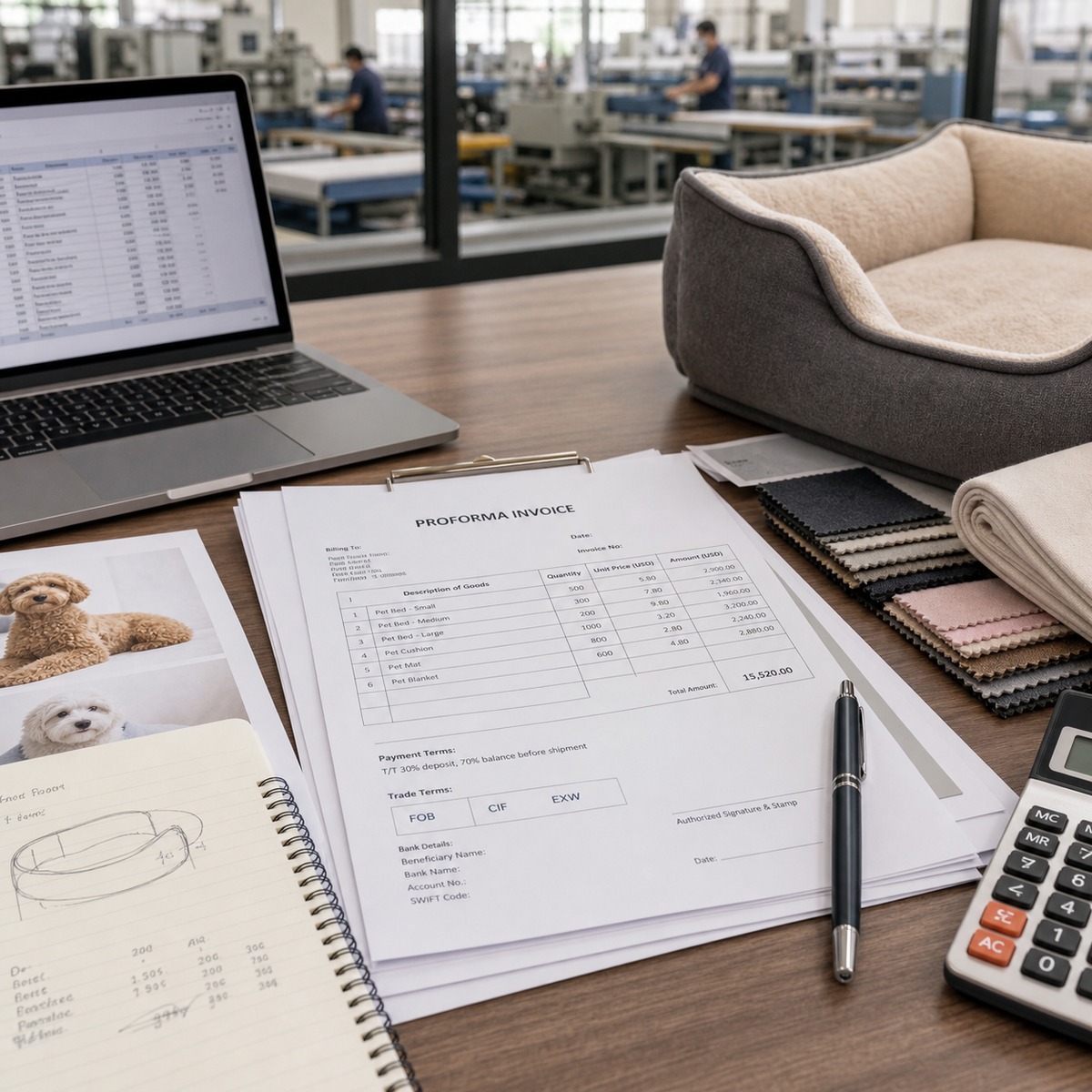
A proforma invoice is a binding commitment — not a quote. Here is exactly what every clause means, where the money moves, and the five mistakes that cause the most disputes between buyers and suppliers.
The proforma invoice (PI) is the document that turns a product inquiry into a real transaction. It defines payment terms, trade terms, lead time, and cost responsibility. Most wholesale disputes — delayed shipments, unexpected fees, missed deadlines — trace back to a PI clause that was misread or ignored. This guide walks through every key section so you know exactly what you are agreeing to before you sign.
How Payment Works: From Deposit to Delivery
PetFangFang operates on a standard 30/70 payment structure. Here is the exact sequence of events — and what triggers each payment.
Customer pays 30% deposit
Production does not begin until the deposit clears. Lead time is calculated from the date the deposit is received in our account — not from the date the PI is signed or confirmed.
Payment triggerProduction, QC, packing, and loading
Goods are manufactured, inspected, packed to agreed spec, and loaded onto the vessel. We handle all domestic export clearance and inland trucking to the port of origin.
FactoryFreight forwarder issues Bill of Lading scan
Once the goods are on board, the freight forwarder issues the Bill of Lading. A scanned copy (B/L copy) is sent to the buyer as proof of shipment.
ShipmentCustomer pays remaining 70% balance
The balance is due upon receipt of the B/L copy — before original documents are released. Payment at this stage is a condition of receiving the Bill of Lading, which is required to clear customs at the destination port.
Payment triggerOriginal B/L or Telex Release sent
Once the balance is confirmed, we release the original Bill of Lading by courier or issue a Telex Release (electronic release instruction to the shipping line). The buyer uses this to collect the goods at the destination port.
Document releaseLong-term buyer terms
Established buyers with a track record of on-time payment may negotiate adjusted payment schedules. The structure remains 30% deposit before production, with the 70% balance due before shipment — consistent with standard industry practice for trusted relationships.
FOB, CIF, and EXW: What Each Term Actually Means
Trade terms define exactly where the seller's responsibility ends and the buyer's begins. Getting this wrong is the single most common source of unexpected costs and post-shipment disputes. Here is what each term means in practice.
Free on Board — Ningbo Port
Cost, Insurance & Freight — Named Destination Port
Ex Works — Factory
| Cost Item | FOB Ningbo | CIF Destination | EXW Factory |
|---|---|---|---|
| Export customs clearance | Seller | Seller | Buyer |
| Inland trucking to port | Seller | Seller | Buyer |
| Ocean freight | Buyer | Seller | Buyer |
| Marine insurance | Buyer | Seller | Buyer |
| Destination port clearance | Buyer | Buyer | Buyer |
| Import duties & taxes | Buyer | Buyer | Buyer |
| Inland delivery at destination | Buyer | Buyer | Buyer |
Where Buyers Go Wrong — and How to Avoid It
These are the five PI-related disputes we see most frequently. Every one of them is preventable by reading the PI carefully before signing.
The most frequent dispute. Buyers assume FOB means the seller delivers the goods to their warehouse or Amazon FBA center. FOB means the seller's responsibility ends the moment goods are loaded onto the vessel at Ningbo. Everything after that — ocean freight, insurance, destination port fees, customs clearance, and last-mile delivery — is entirely the buyer's cost.
✓ FOB = seller loads on ship. Buyer pays everything from that point forward.
Some buyers assume the balance is paid when goods arrive at the destination port. This is incorrect. The 70% balance is due upon receipt of the B/L copy — which is issued when goods are loaded in China, typically 4–6 weeks before arrival. Delaying payment causes the shipping line to hold the Bill of Lading, which results in demurrage charges at the destination port that are the buyer's liability.
✓ Balance due on B/L copy — not on arrival. Delay = demurrage at your cost.
A PI is valid for 7 to 15 days from the issue date. If the deposit is not paid within this window, the PI expires and the quoted price is no longer valid. When raw material costs or freight rates change, the factory issues a new PI at the current price. Buyers who return after the validity window expecting to lock in the original price have no basis to do so — the offer has lapsed.
✓ Pay the deposit within the PI validity window or request a reissue before it expires.
No matter which trade term applies — FOB, CIF, or EXW — import duties, VAT, consumption tax, and any other government levies at the destination are always the buyer's responsibility. These vary significantly by country and product category: US import duties on pet products, EU VAT rates by member state, and tariff classifications all differ. The seller has no way to estimate or guarantee these costs — and the PI will explicitly state that all import taxes are buyer's liability.
✓ Import duties are always buyer's cost. Check your country's tariff schedule before placing the order.
Lead time on the PI is stated as a number of days from deposit receipt — not from the date you sign or confirm the PI. If a PI shows "20 working days" and you sign today but take 5 days to transfer the deposit, production begins when the funds clear, not when you signed. Buyers who book logistics or set customer expectations based on the PI date rather than the deposit date consistently encounter delays.
✓ Lead time starts when the deposit clears in our account — plan your logistics from that date.
PI Checklist: What to Verify Before Signing
| PI Item | What to Check |
|---|---|
| Trade term | FOB / CIF / EXW — know exactly where your cost responsibility begins |
| Port of loading | Ningbo for Yiwu-sourced goods; confirm this matches your freight forwarder's routing |
| Payment terms | 30% deposit before production; 70% balance on B/L copy — not on arrival |
| Lead time | Counted from deposit receipt date — not PI confirmation date |
| PI validity | 7–15 days — deposit must be paid within this window or PI expires |
| Tax and duty clause | All destination import duties and taxes are buyer's responsibility — always |
| Product specifications | Verify sizes, quantities, colors, and unit prices match your confirmed sample order |
| Bank details | Confirm account details match your previous correspondence — wire fraud risk |
Ready to Place Your Order?
Browse our pet bed collection and request a proforma invoice — we will walk you through every line item.
Browse Dog & Cat Beds