Before you sign off on any shipment — a 10-point inspection framework every wholesale dog bed buyer should use.
Receiving a dog bed sample without a structured inspection process is how quality problems make it into your first bulk order. This checklist covers every point that matters — dimensions, materials, workmanship, safety, and seasonal fit — so you can approve or reject samples with confidence and document everything in writing.
10 Inspection Points for Every Dog Bed Sample
Work through each point in order. Document measurements and findings with photos during inspection — this creates a paper trail you can reference if defects appear later in the bulk shipment.
Dimension Verification
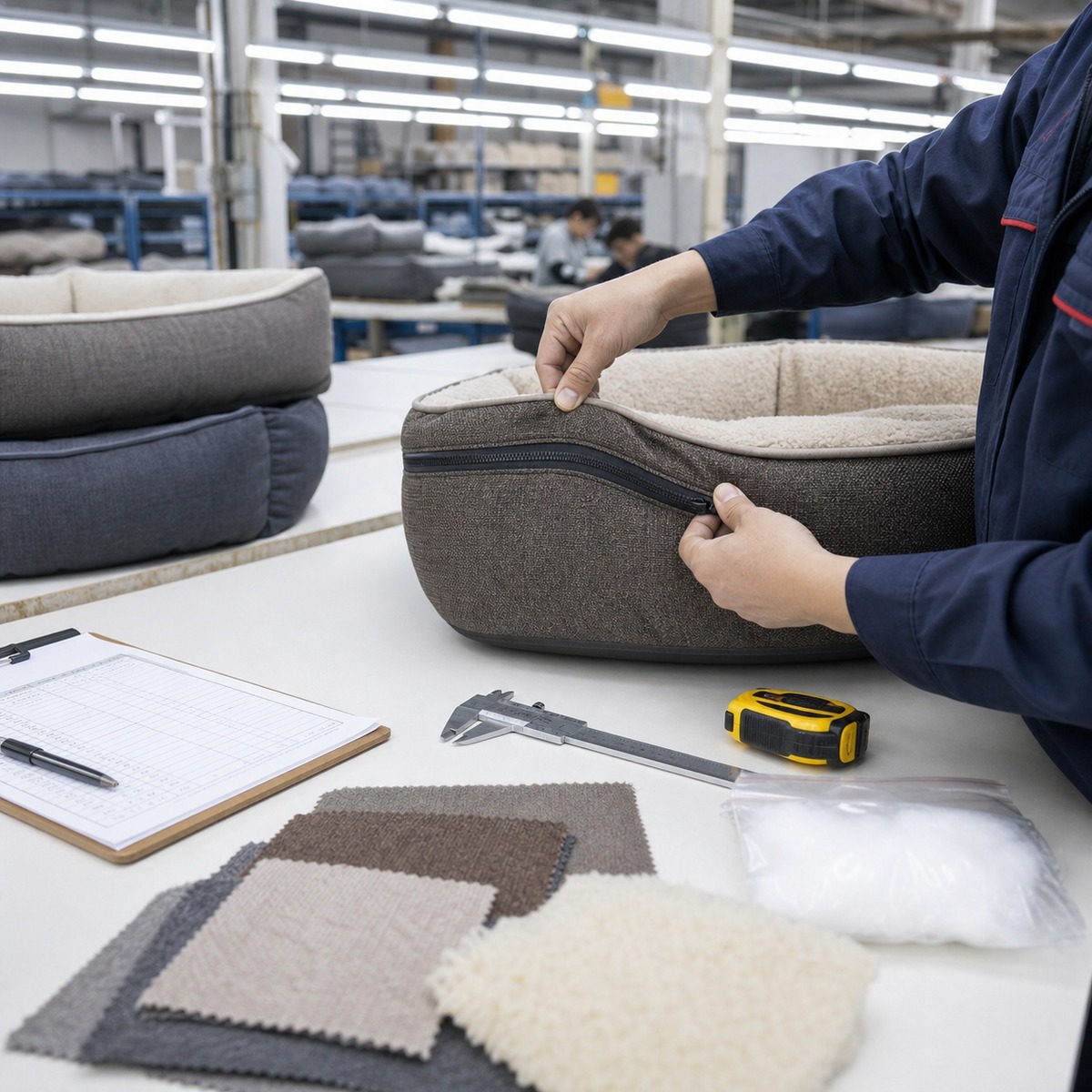
Measure actual length, width, and height with a tape measure and compare against the spec sheet dimensions. Dimensional errors compound at scale — a 3 cm error per unit across 500 pieces creates consistent customer complaints. For puppy beds, verify sufficient growth allowance; for adult dogs, confirm the bed allows natural lying flat, turning around, and curled sleeping without crowding.
Fabric & Material Quality
The outer fabric should feel dense and durable — rub firmly with your palm for 20 strokes and check for pilling or snagging. The inner lining (if fleece or plush) should not shed loose fibers when rubbed. Reject any sample where the outer shell feels thin and papery, or where the inner surface sheds visibly — recycled synthetic fibers fail quickly in real-world use and generate negative reviews.
Odor Inspection
Open the packaging and hold the bed close — any strong plastic, chemical solvent, artificial fragrance, or sharp formaldehyde smell is a hard reject. A mild, neutral fabric smell that dissipates within a few hours of ventilation is acceptable. Strong odors indicate off-gassing from cheap glues, dyes, or foam — these do not fully dissipate and are a health concern for pets spending 12+ hours per day on the surface.
Fill Material Inspection
Press firmly across the entire surface and release — rebound should be even, with no flat spots, thin patches, or areas where fill has migrated. Open a corner seam slightly and visually inspect the fill: it should be clean white PP cotton, memory foam, or slow-rebound sponge with no dark specks, dust, or compressed debris. Squeeze and release a handful — it should not clump or stay compressed. Black-heart cotton (recycled waste fiber) is a common cost-cutting substitution that is very difficult to detect without opening the bed.
Stitching & Construction
Inspect all seams under good light for consistent stitch density — loose, skipped, or uneven stitches indicate machine tension problems that cause premature seam failure. Check all corners and edges for reinforced stitching. Tug the seams gently to test holding strength. Test the zipper (if present) through 5 full open-close cycles: it should run smoothly with no fabric catching, no skipping teeth, and no zipper head wobble. A cheap zipper head will fail within weeks of regular washing.
Non-Slip Base & Waterproof Membrane
Place the bed on a smooth floor and push it sideways with moderate force — a properly designed non-slip base (silicone dots or rubberized fabric) should resist movement. Plain nonwoven fabric bases slide freely and are a significant safety issue for active dogs on hard floors. Flip the bed and inspect the waterproof membrane (if specified): it should be continuous with no gaps, pinholes, or delamination at edges. A compromised membrane allows moisture to penetrate and degrade the fill.
Removable & Washable Design
If the spec calls for a removable cover, unzip and fully remove the outer shell, then re-attach it. The process should be smooth, intuitive, and require no tools. Confirm that the inner cushion can be washed separately. One-piece non-removable beds are significantly harder to keep hygienically clean over the product's lifetime — owners cannot properly wash or dry the fill layer, leading to odor buildup, mold risk, and early disposal. This is a key feature to verify matches the spec.
Firmness & Long-Term Support
Sit or press down on the center of the bed with sustained pressure for 30 seconds, simulating a dog's resting weight. On release, the bed should recover to at least 90% of its original height within 10 seconds. A bed that stays compressed indicates insufficient fill density or low-grade foam — it will flatten permanently within weeks of use, eliminating the joint support benefit that differentiates premium pet bedding from commodity alternatives.
Safety Details
Check for any decorative elements that could become choking hazards: buttons, ribbon ties, glued-on appliques, or loose fringe. Inspect all edges and seams for exposed hard plastic components or sharp stitching ends. Test colorfastness by pressing a damp white cloth firmly against the fabric surface for 10 seconds — significant color transfer indicates dyes that will stain pet fur and the dog's skin over time. These safety failures create liability exposure and return surges.
Seasonal Thickness Match
Compare the actual thickness and fill weight against the seasonal specification. An all-season bed should have a balanced 3-4 cm fill profile. A winter bed should feel visibly lofty and retain warmth when cupped in both hands. A summer cooling bed should have minimal fill and a breathable surface — dense fill in a "summer" bed causes heat retention and defeats the product's purpose. Weigh the completed unit and compare against the specification sheet.
Acceptable Deviation Limits
These are the numeric tolerances that apply to every PetFangFang sample. Any deviation beyond these limits requires a correction before bulk approval is granted.
| Specification | Acceptable Tolerance | Notes |
|---|---|---|
| Fabric weight (gsm) | Max -5% negative deviation | Positive deviation (heavier) is acceptable |
| Total fill net weight | +/-5% strictly | Both over and under are controlled |
| Long-pile inner lining weight | Max -6% negative deviation | Critical for warmth and loft performance |
| Overall dimensions (L/W/H) | +/-2 cm per axis | Measure at 3 points per dimension, use average |
| Colorfastness (wet rub) | Grade 3+ (ISO 105-X12) | No visible transfer on white cloth at grade 3+ |
Why fill weight tolerances matter
Fill weight is the single most commonly manipulated cost variable in pet bedding manufacturing. A 10% fill reduction across 1,000 units translates directly to finished products that flatten faster and generate higher return rates. Weighing fill at goods inspection is the only reliable way to catch this substitution before shipment.
Sample Revision Terms
Knowing the revision terms before you start inspection prevents timeline surprises and keeps your sourcing schedule on track.
Effective feedback speeds up revision
Vague feedback ("the quality isn't good enough") leads to multiple rounds of misaligned corrections. Reference specific inspection points by number, include measured dimensions versus expected, and attach close-up photos of the defect area. A precise revision note on Day 1 typically resolves the issue in a single correction cycle.
Reject On Sight — No Revision
Some defects are serious enough to reject the sample outright rather than request corrections. These issues indicate systemic manufacturing problems that revisions are unlikely to fully resolve.
Immediate rejection criteria
- XBlack-heart cotton or contaminated fill — any visible dark fibers, dust, or foreign material in the fill layer indicates recycled waste fiber. This cannot be corrected through revision; it requires a full material substitution.
- XStrong persistent chemical odor — odors that do not dissipate after 24 hours of open-air ventilation indicate formaldehyde or volatile chemical residues from adhesives or dyes that cannot be removed after production.
- XColorfastness failure below Grade 3 — heavy color transfer on wet rub indicates unstable dyes that will stain pet fur and skin. This is a materials failure, not a workmanship issue.
- XSharp exposed edges or detachable small parts — any structural element that could injure a dog or be swallowed creates product liability exposure. Safety failures are non-negotiable.
- XFill weight more than 15% below specification — a deviation this large indicates intentional material substitution, not a production variance. The entire fill spec must be re-confirmed in writing before re-sampling.
Ready to Request Your Sample?
Browse our Dog & Cat Bed collection and contact us to start the sample process. Most sample inquiries receive a response within 24 hours.
Browse Dog & Cat Beds